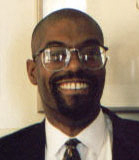
| W. Alston Reddy
(1954-2001) was a dedicated and fierce advocate for people with
disabilities who came to the practice of law as a second career.
Alston had worked as a talented television journalist for ABC in his
hometown of Philadelphia. “My (family) had pushed me to be as
successful as possible. For them that meant financial, an outward
display of wealth. And to me, being successful means spirituality and
helping people. The happiest I had been in the TV station was when I
was doing public affairs work and doing the stories that the news
department wouldn’t do—covering Native American stories or stories
of oppression…” He did so well that he was moved into
covering other kinds of news and stories. “I didn’t like who I
was. I didn’t like the fact that I wasn’t contributing and so I
went to law school.”1 Awarded a full
scholarship to the University of Nebraska College of Law, he was
considering another type of practice until he interned at Nebraska
Advocacy Services. NAS works to protect the rights of people with
significant mental or physical disabilities. When he was admitted to
the bar in 1994 he went to work fulltime there.
As an African
American gay man, Alston faced discrimination throughout his life. He
never ceased to be outraged at discrimination towards any person. He
had developed a variety of tools for dealing with opposition that he
applied to his advocacy work and added some new ones. People who
opposed him never knew what to expect. He could be scathing,
intimidating or cooperative. At times he would appear with
shaved head, starched white shirt, bow tie and glasses a la Farrakhan.
“It kind of came
to me why I like this job when I showed up one morning with a
paralegal…We got out of the car, some farm town maybe two to three
thousand people, and this complete stranger runs out of the school.
It’s maybe 2 degrees outside; it’s high wind. She grabs me and
won’t let go. I’m like ‘Don’t touch me.’ I’m from the
city. You don’t touch people; you die like that. She’s all
exuberant. I calm her down. ‘You’re that attorney people are
talking about all over the state who gets results. You’re the person
who makes the school district cringe. If you helped those other
people, maybe you can help my son, too.’
The opposing
counsel “had been in practice for 30-35 years. I’ve been in
practice ten minutes! My stomach turns to jelly. He sees me,
(gasps) and says ‘Let’s talk.’ In a ten-minute conference,
I got everything I wanted. The kid needed a teaching assistant…After
that it was like I could do no wrong.” And the opposing
counsel was telling everyone “about that bright new attorney with
the attitude from hell. I started to like my job.”
As a new lawyer,
he learned about Benchmark Institute when he attended the 1995 NAPAS
(National Association of Protection and Advocacy Systems) Conference
where we conducted a legal skills training. He sat in the front eager
to absorb all that he could. The following year he participated in
Benchmark’s Trial & Hearing Skills Training and became a
lifelong supporter of Benchmark.
He was active in
the Nebraska Bar Association, served on the Legislative Committee and
was proud of the changes in guardianship law that were effected during
his tenure. “I got to change state law here.” He served on the
editorial policy committee of the Nebraska State Bar publication The
Nebraska Lawyer. “They had never had a person of color
write for it or be editor. They had never had a woman write for it or
be on the cover and I brought all these issues up.” He then
called every state bar in the country to request a copy of their
publication and to show how things could be changed.
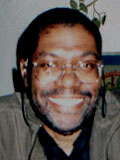 After Alston was
diagnosed with AIDS he had to begin to advocate for effective health
care for himself and to coordinate the many doctors he had to see.
When it became apparent that the medications that were supposed to
help were actually making things worse for him, he decided to stop
taking them. “After fighting for 22 months I’m exhausted. I’m
leaving probably the first and only job I have ever loved so I can
retire so I can live a little longer.” After Alston was
diagnosed with AIDS he had to begin to advocate for effective health
care for himself and to coordinate the many doctors he had to see.
When it became apparent that the medications that were supposed to
help were actually making things worse for him, he decided to stop
taking them. “After fighting for 22 months I’m exhausted. I’m
leaving probably the first and only job I have ever loved so I can
retire so I can live a little longer.”
“I asked Alston
Reddy who has dedicated his law career to the practice of public
interest law and who is now slowly dying of AIDS, how much he misses
his law practice and his eyes immediately filled up. ‘I didn’t
realize how much I truly loved the practice of law until I couldn’t
do it anymore.’ Alston told me one evening. He continued, ‘Not
having the ability to help people is painful for me.’”2
“The last two
years have taught me something—that I can believe in myself, that I
can help other people. I found myself helping other people in the
middle of all this. I don’t know where I got the strength to do
stuff like that. It’s taught me to love. And it taught me to be
comfortable with myself…about being a black man in America, that I
can handle whatever comes my way in spite of the messages that I
receive daily from outside sources.”
After his death
Alston wanted his friends to be notified that “Alston has exited the
building.” But he’ll never leave our hearts.
W. Alston Reddy Scholarship
Before Alston died
he talked with us about a scholarship. He liked that fact that we had
established scholarships to our training in memory of friends and
family and wanted to have a fund established in his memory.
We honor
Alston’s spirit by awarding this scholarship to an advocate with the
kind of dedication to their clients, commitment to excellence,
lifelong learning and practice of public interest law that Alston had.
Previous Recipients
Yvonne Cudney, Legal Aid Foundation of Santa Barbara County
Kathryn Hardy, California Rural Legal Assistance Foundation
FOOTNOTES
1.
Unless otherwise attributed, quotes are from an unpublished video
interview with Alston, April 12, 2000, Lincoln, Nebraska.
2. Michael N. Dolich, Seeking
Joy in the Practice of Law: A Personal and Professional Journey,
The Nebraska Lawyer, August 2001
|